

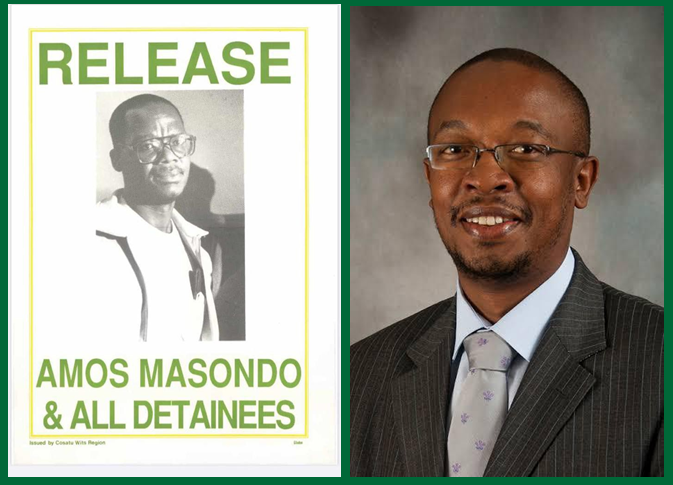
When you are asked to speak in honor of two great comrades that you have observed navigating the political terrain and challenges, both within the movement and the state, a few questions come to mind. One: how do you best describe the two in a manner that you are not found to have grossly misrepresented them?
I have decided that I will posit my honour to them through the following questions:
- What experience and history shaped their outlook?
- What are the values that define an activist?
- How have the above shaped the two cadres in the performance of their responsibilities wherever they were deployed and what are the legacies they have left both in the political arena and the state?
- What is it that the current contingent of cadres can learn from the revolutionary morality these selfless individuals’ displayed; in the face of leadership crisis, entrenched factionalism, ill-discipline, and other ills confronting our movement?
What experiences and history shaped the outlook of these two great Comrades?
The early years of colonizers (political)
The history of the wealth of our country is the history of the ruin and the expropriation of the Black African population from its native soil. As far back as the 17th century, the colonisers had landed in South Africa, conquered the plains of our south- ern-eastern parts of the country, and driven back the native Khoi and San into the mountains. The Portuguese (e.g. Vasco da Gama), the Dutch (e.g. Jan van Riebeck), the French (e.g. Simon van der Stel), and the British (e.g. the notorious Sir Harry Smith) all partook in plundering and dominating the land where they settled. From the late 1820s, the ultimate and real usurpation was enacted through the forcible transformation of communal property and the disenfranchisement of native populations through the imposition of taxes and the limiting of livestock to be owned.
Apartheid and the Movement’s response
Later most Black Africans were forcefully removed from their urban areas for white settlements and development (e.g. District Six, Waaihoek, Sophia- town, etc.) and Blacks were allocated to cramped “temporary” areas meant for cheap labour in the country (townships). These areas had no sufficient infrastructure and no dignified services. The black areas were governed by unelected, but nominated representatives to control and administer the Apartheid Racial Laws – Black Local Authorities.
The Apartheid regime had, earlier since its establishment, contrived to make the Black Local areas townships- and rural spaces the most miserable abodes of the world.
Response: It was in the early eighties that the concept of “Peoples Power” and the parallel intensified push of “Rendering the Apartheid Government Ungovernable”, that the birth seed of a Democratic Local Government was planted.
The UDF publication Isizwe, 1986 stated: “the building of people’s power is something that is already beginning to happen in the course of our struggle. It is not for us to sit back and merely dream of the day that the people shall govern. It is our task to start to realize that goal now. We must start the process of liberating South Africa.
We must begin to place power in the hands of the people, in all spheres…Even in the present we must start to build the beginnings of our future society.” Emphasis mine.
At governance/State
Over the past 20 years, the Local Government has made great progress in the provision of housing, water, sanitation, and electricity to millions of people who never had access to such services. The local Government has been remaking our cities, towns, and rural spaces as liveable, quality, affordable, sustainable communities and offering more residential, transport, and conducive areas for economic development.
Local Government institutions in South Africa have been, and are still, shaped by nearly 300 years of colonialism and it will take nearly equally long to completely get rid of those colonial legacies.
Challenges
Many municipalities in our country are faced with structural challenges and dwindling fiscal allocations, coupled with the collapse of effective systems for good administrative performance, dwindling service delivery levels plus lack of ethical governance at the fiduciary oversight level.
Financial mismanagement, looting of state coffers without impunity in government, has paralysed administration, leadership, and service delivery at all levels in the sector. The disruptive nature of these events in state institutions threatens and undermines democratic gains freedom and legitimacy we have attained as a movement over the past three decades.
The two leaders we honoring today have responded to the above challenges through understanding the basic mantra-services to all our people.
Radical restructuring, led by “activists-leadership”, is an essential element necessary for getting rid of the legacies and social ills mentioned above.
The extent to which local government contributes to our nation, economy, culture, and our national character, means that leaders and practitioners need to work and live by certain values.
- Boraine said:
”… people run structures, and at the end of the day, if you put the ‘wrong people’ in the structures, who, as in the case of Donald Trump in the USA, are determined to subvert the institutions, you get poor results no matter what is in the Constitution or in Law”.
For the transformation of our country we don’t need just any person (card-carrying or not) to be deployed to run structures, we need what I call Activists-leaders.
Activists-leaders who are committed to transforming the world to be a better place for all, to inspire all of us.
Activists- leaders reflect the following values:
- Leadership: Leaders lead by example – they continue to practice the art of motivating those they inspire us.
- Integrity: They act with integrity through honesty, fairness, and accountability. When you look at leaders, you admire, the trait that stands tall is They build trust with our communities and society at large.
- Results: They are results-driven. Deter- mined to see things through to the end, with a powerful and productive
- People-centered: They are committed to our people by developing strong relationships with them in order to deliver long-term value. They know that South Africans are at the very heart and soul of why they do what they do. Respect: They treat others the way they would like to be treated
- Teamwork: They create a culture of working together and working together well! They collaborate to create high performing teams and deliver on what they promise.
Did the Leaders we Honour today reflect these values? Did they leave footprints for us to follow? Are we following those footprints? Are we honoring these heroes just for the sake of honoring, or we are eager to learn and improve from where they left off?
To what extent have these values shaped the two cadres in the performance of their responsibilities wherever they were deployed?
These are two leaders who were able to move the city in different transitional epochs:
Comrade Amos Masondo
The father figure who was tasked with moving the various disparate city structures and various other plans hatched during the pre-interim and the transitional phase to the unicity now known as the City of Joburg.
A student activist from an early age, a trade unionist, organizer, and one of the founding members of the United Democratic Front. He has served in the various levels of government (from the municipal level, Provincial level, and National/Parliament level). He also served in various structures such as SALGA, UCLG, and CLGF. Comrade Amos assumed the responsibility of becoming a Mayor in 2000, taking over a municipality that was not performing and experiencing a rapid decline and bankruptcy in the late 90s.
Under his leadership, the process of restructuring was entrenched leading to the consolidation of the various sub-councils in CoJ took a mere six months. A single local authority was created for the city and eventually an effective system of metropolitan government was harnessed.
During his reign, the concept of urban and or inner-city regeneration took shape and the city identified five priorities to this effect, which became the Bible or song of the city recited by all the city employees. Those who were there will remember these:
- Inner City revitalization/regeneration
- Housing provision
- Health provision
- Fighting HIV/Aids and
- Investing in township revitalization and development
You will note the tarring of all Soweto streets was done within the planned time and on budget. All this was achieved because of two things that defined the old man, fear of failure and respect for community views.
I spoke to one of the former employees, who gave me a very interesting example of a matter that was once raised in a community Imbizo about the rats in Alex and Eldorado Park who were bigger than the cats and were chasing the cats. He would demand to know what is being done about the rats and cats of these areas. So, all issues raised by communities became programs of the city and had to be followed up for implementation.
What is reflected above cannot define all the areas that uBaba Masondo achieved, but is just the tip of an iceberg.
Comrade Parks Tau
A young contrarian at heart, a leader spawned in the annals of an ANC, from branch to PEC level, and made a huge impact in the governance arena.
Like Comrade Amos, he became a student activist at an early age taking up leadership roles in student politics. Comrade Parks is a well-rounded and fully developed cadre with local, regional, national, and international experience. He tackled, with his team, challenges brought about by climate change. In the process, he introduced both the corridors of freedom and eco-mobility for the city. He facilitated the Green Bond concept and positioned CoJ to be a truly African City of the world.
At the governance level, he served at the Southern Metropolitan Local Council’s Urban Development Committee and was later appointed the MMC for Planning in the City of Johannesburg, dealing with issues of Spatial Planning. He was also appointed as the MMC for Finance and later assumed the Mayoral Position in the City of Johannesburg.
Like Comrade Amos, Comrade Parks was actively involved in the leadership roles in various important structures both locally and internationally including SALGA, UCLG, CLGF, United Nations High-Level Independent Panel, and the World Resources Institute (WRI). The rise of Comrade Parks may not have been designed but was predetermined by the results of the value-driven and teamwork.
There is something unique about these cadres we are celebrating today. Their leadership is not about noise as empty vessels. Their leadership is grounded on respecting the very communities that gave them the platform to lead. They are focused on the practice of handling matters that seemed complex and their humility in navigating all matters political and in governance.
It is important that we also recognize that these cadres are no moral saints with no interests. Both have been committed to a sincere and genuine course of putting the interest of our communities first and they have always reminded us of what it means to be a card-carrying member of the ANC and how we should define ourselves through our responsible conduct as cadres of this movement. They are activists driven by a deep sense of indignation on inequality, and growing poverty levels prevailing in our country.
In our genre, we can be able to say these cadres ba-rabble (well-groomed and trained), and whether you allow them to be filtered by the movement’s through the eye of the needle, you are guaranteed that indeed they will emerge on the other side. Can we say the same about many of us, our comrades of today?
What is it that the current contingent of cadres can learn from the revolutionary morality these two individual leaders displayed in the face of revelations in state capture, leadership crisis, entrenched factionalism, ill-discipline, and other ills confronting our movement?
I challenge all of us to go back to basics and:
- Understand the freedom charter to ground our political focus on the 12 issues raised therein, and how the world is evolving within
- Understand the NDR
- Understand the meaning of ANC leading and your role in ensuring it
- Base your decisions on proper analysis of facts informing your
- Never be silent about things that matter the center that should hold in our focus, in our conduct and performance is the one and only-The ANC Pledge:“…, that I will place my energies and skills at the disposal of the Organisation and carry out tasks given to me, that I will work towards making the ANC an even more effective instrument of liberation in the hands of the people, and that I will defend the unity and integrity of the Organisation and its principles,..” This declaration is our framework and outlook.
- There is no better time than now to hold a mirror to ourselves and evaluate our commitment to building an effective state and a South Africa we all can be proud of. This calls for activist-leaders as discussed in this meeting- are u daring to be one?
Remember: “all erroneous ideas, all poisonous weeds, all ghosts, and monsters, must be subjected to criticism; in no circumstance should they be allowed to spread unchecked. However, the criticism should be fully reasoned, analytical and convincing, and not rough, bureaucratic, metaphysical or dogmatic- but should not lead to factionalism”.
It is said that:
Our lives begin to end the day we become silent about things that matter.
It is then befitting for us, this movement, the Jhb Region, to ask: “Are our lives beginning to end because we are silent about things that matter?
Let us recommit ourselves to the values of Activist-leadership as reflected in this speech and declare that our lives, our movement will never end and die in our hands.